The Leeuwin-Naturaliste National Park is located on the south-west coast of Western Australia, 261km from Perth. The park lies in the Aboriginal land of the
Wardandi (people of Warden, the ocean spirit). The wardandi are one of the fourteen
Nyungar tribes that live in the South-West.

Their land extends from the coast at Stratham to the sea at Augusta. The park stretches for 120km, from Bunker Bay in the north to Augusta in the south. Cape Naturaliste is the northern most point in the park. The first noted Europeans to have sighted the area were
the Dutch, in 1622. They named the southwestern tip "t Landt van de Leeuwin" meaning the land of the lioness.
It was later explored by
Matthew Flinders , in 1801, who renamed it Cape Leeuwin with respect to the Dutch who had first sighted the rocky headland.The area became a popular place for whalers and sealers to collect fresh water and to seek protection from the storms that whipped up off the southern ocean.
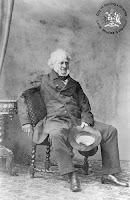
However the area was officially settled by Europeans in 1830 after the establishment of the Swan River Colony. New settlers who had arrived in Fremantle on the ship "
Warrior" on 12th of March, 1830, were hoping to take up land near the Swan River Colony but, Lieutenant-Governor James Stirling, knowing that all of the fertile land had already been taken up, persuaded the settlers to move south, to an area near Cape Leeuwin.
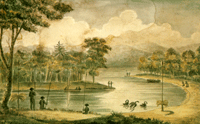
Captain Molloy, a small military detachment and about thirty settlers headed south and arrived in an area near the Blackwood River . Among the new settlers from the "Warrior" were Captain John Molloy and
his wife Georgiana and John, Charles, Vernon & Alfred Bussell (who all became influential in the development of other areas in the south-west).
The site was named, Augusta, by James Stirling in May 1830, in honour of Princess Augusta Sophia, the second daughter of King George III and Queen Charlotte.

With very few of the settlers having a history or background in agriculture, it didn't take long before they discovered how hard life was on the harsh landscape.
Supplies from Perth came infrequent and small relief was found through the Whalers (predominantly American), who came ashore to collect fresh water and trade with the settlers. The settlers would exchange potatoes, meat and vegetables for much needed oil (for lighting), molasses and tobacco. However, even with the whaler trade, many settlers found the isolation and harshness of the area too much and they left Augusta including the Bussells and Malloys.
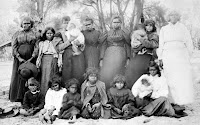
The settlers that stayed, used the local Aboringines to help clear the local hardwood timber and assist with crops and with the introduction of convicts to Western Australia in 1850, many convicts were given tickets-of-leave and sent to Augusta help the settlers cut timber (Jarrah & Karri ).
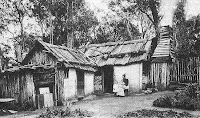
The banks of the Blackwood River were used to house convicts & guards and where timbers were pitsawn before they were loaded onto rafts and floated down to the mouth of the river (as Jarrah does not float).It would, however, be another twenty years before Augusta would flourish, due to the timber industry and a man named
Maurice Coleman Davies. M.C. Davies established sawmills at Coodardup, Karridale, Boranup and Jarrahdene in the late 1870's and almost
singlehandedly create a market and efficient industry for Karri and Jarrah hardwoods which was highlighted in the Paris Exhibition in 1878.
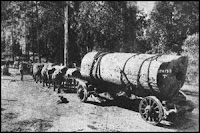
By the 1880's the timber industry was booming and mills, jetties, towns and a railway were built to cope with the demand for Western Australian hardwoods. Timber became Western Australia's second largest export, behind wool.
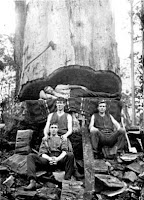
By the early 1900's the demand for Karri and Jarrah from the area had declined and the last mill was closed in 1913.
After the first World War many returned soldiers took up dairy farms in the area. Augusta is now a popular holiday resort, with among its attractions being the Cape Leeuwin Lighthouse and waterwheel, Jewel Cave, Boranup Forest and whale watching tours it also boasts pristine beaches, great fishing and friendly pelicans.
In 1957 the Leeuwin-Naturaliste National Park was established from crown land along the Leeuwin-Naturalist ridge and is managed by the Department of Conservation and Land Management.
Info from
Margaret River Vista and google images.


 When: Friday 11 December after work
 What you definitely need to take hiking:
 - Take something for all weather types, although it's summer it can be cold and rainy.
  hips (what I prefer)
  The closeness of the forest to the coast has provided for one of the most well set up National Park campgrounds in Australia, at Conto Fields. Conto's is also one of the most beautiful beaches in the area, named by a local fisherman after a brand of wine which they used to drink in the 1950s. The fishermen built a shack on the isolated beach, which is now surrounded by vast quantities of empty bottles and flagons - testimony to many nights spent fortified against the cold by their favourite drop.
 Conto's Beach and its surrounding bays are part of the Leeuwin-Naturaliste National Park and were originally part of a pastoral lease held by one of the founders of the area, A.P. Bussell. The lease changed hands a number of times - in the 1920s it was used as a pony stud. In the 1950s the paddock was cleared to graze cattle. The stock was walked a few kilometres around the cliff to be watered at a spring on the beach.
 Each campsite in Conto's Field has a firepit, tabel setting, grass sites and shade.
 Until a few years ago the only access to the beach was either the 4WD track or a long walk around the cliff. The Department of Conservation and Land Management (CALM) put a major road through to Conto's and the bays further south. At the time the decision to put the road through caused quite a lot of controversy but the decision was prompted by a number of drownings in the area. Decent access was required if any rescues were necessary. CALM has since provided some excellent camping facilities just a few kilometres from the beach. Sites are cleared, secluded areas surrounded by bush and all have fireplaces and picnic tables. Some of the sites are perfect for a couple or family, while others cater for large groups. Jarrah millends are provided for fires and bush toilets are available.
 Camping kitchen and even caravans and campers find their way in.
 During the winter of 2000, CALM did major work on improving the sites and adding some new circuits and more campsites. there is now more than enough room to find a bit of privacy at all but the busiest of times. Campers can either stay at Conto Field camping area which has many comfortable spots, or at a few limited sites in the magnificent Boranup Karri Forest. Tracks pass through the forest and into low woodlands of peppermint, banksia and jarrah. The tracks emerge in coastal scrubland, which supports communities of animals including kangaroos and goannas, then continue onto the coastal bays and beaches. If you stay in the forest you will be overwhelmed by the local possums - a rare experience in WA.
 Visitors to Conto's or Boranup should bring their own water or collect it from the spring on the beach, (it is a long walk back to the campsite with a heavy water container so don't overdo it). There is a rainwater tank at the main camping area and it usually has enough water but supplies are limited. Rangers collect a minimal camping fee and supplies can be obtained at Margaret River or Witchcliffe. You can also get great lunches and limited supplies from the cafe/kiosk at Lake Cave. Many of the Margaret River vineyards are close by and most of them serve an excellent lunch.
 Their land extends from the coast at Stratham to the sea at Augusta. The park stretches for 120km, from Bunker Bay in the north to Augusta in the south. Cape Naturaliste is the northern most point in the park. The first noted Europeans to have sighted the area were the Dutch, in 1622. They named the southwestern tip "t Landt van de Leeuwin" meaning the land of the lioness.
  However the area was officially settled by Europeans in 1830 after the establishment of the Swan River Colony. New settlers who had arrived in Fremantle on the ship "Warrior" on 12th of March, 1830, were hoping to take up land near the Swan River Colony but, Lieutenant-Governor James Stirling, knowing that all of the fertile land had already been taken up, persuaded the settlers to move south, to an area near Cape Leeuwin.
 Captain Molloy, a small military detachment and about thirty settlers headed south and arrived in an area near the Blackwood River . Among the new settlers from the "Warrior" were Captain John Molloy and his wife Georgiana and John, Charles, Vernon & Alfred Bussell (who all became influential in the development of other areas in the south-west).
 With very few of the settlers having a history or background in agriculture, it didn't take long before they discovered how hard life was on the harsh landscape.
  The settlers that stayed, used the local Aboringines to help clear the local hardwood timber and assist with crops and with the introduction of convicts to Western Australia in 1850, many convicts were given tickets-of-leave and sent to Augusta help the settlers cut timber (Jarrah & Karri ).
  The banks of the Blackwood River were used to house convicts & guards and where timbers were pitsawn before they were loaded onto rafts and floated down to the mouth of the river (as Jarrah does not float).It would, however, be another twenty years before Augusta would flourish, due to the timber industry and a man named Maurice Coleman Davies. M.C. Davies established sawmills at Coodardup, Karridale, Boranup and Jarrahdene in the late 1870's and almost singlehandedly create a market and efficient industry for Karri and Jarrah hardwoods which was highlighted in the Paris Exhibition in 1878.
 By the 1880's the timber industry was booming and mills, jetties, towns and a railway were built to cope with the demand for Western Australian hardwoods. Timber became Western Australia's second largest export, behind wool.
  By the early 1900's the demand for Karri and Jarrah from the area had declined and the last mill was closed in 1913.
  Join Environmental Encounters on this 8 day, small group expedition on the Cape to Cape Track in the Leeuwin-Naturaliste National Park.
 There is a rule among locals that it's best to have a jumper in the car at all times.
  Hi Wilma!
 My name is Wilma and I love to camp in the bush, I love nature and what is better than combining a workout in nature with your best friends? A few years ago Pajda, a student friend, did the Cape to Cape walk over Christmas and had good stories so when Helen mentioned that she liked to do something together with us during their trip to Australia I suggested the walk and there it started. I mentioned it to some local friends with whom I regularly walk and they got interested as well. I am a good organiser and to get everyone else organised as well I started this blog. So with a bit of luck we have a great trip down south at the end of the year!
  The total of maps 1-4 is 34 km and that includes Meelup Trail. Without Meelup Trail it's 20.5km and should be enough for the first day.
  Plans are still in the making, one of the plans is that we are going to set up a base camp, probably in Boranup forest or maybe at Conto's as people might want to have a shower after a long day of walking. Boranup bush camp has only a toilet.
  Or we can move camp every day which is not sure yet as we don't know if every camp is reachable by car and migth involve a lot of logistics.
  Another idea is to take all the stuff in a backpack and camp along the track in the provided camp spots. This requiers a sweaty backpack including dried and ligthweight food and carrying a lot of water.